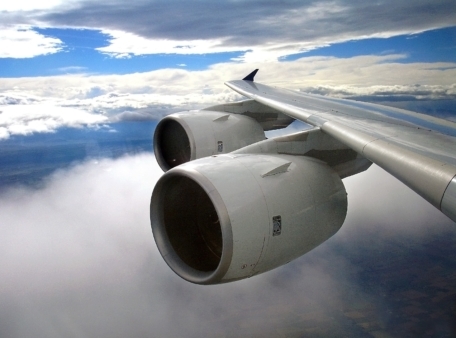
The aviation industry must accelerate its transition to sustainability in order to reduce its climate impact and meet European emissions targets. New, sustainable technologies are needed to produce lighter aircraft.
Objective
The HyWeld project focuses on joining two types of materials: thermoplastic composites and thermosetting composites. The main difference is that a thermoplastic softens when heated and can be moulded into any desired shape. A thermosetting material, on the other hand, retains its shape and structure when heated. Currently, thermosetting materials are predominantly used in the aviation industry.
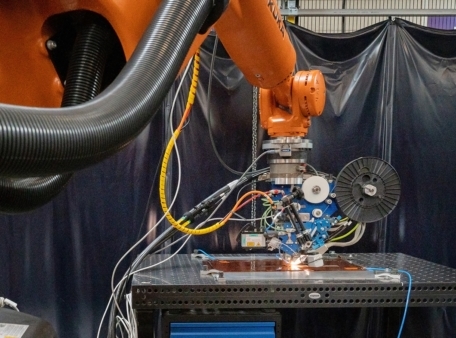
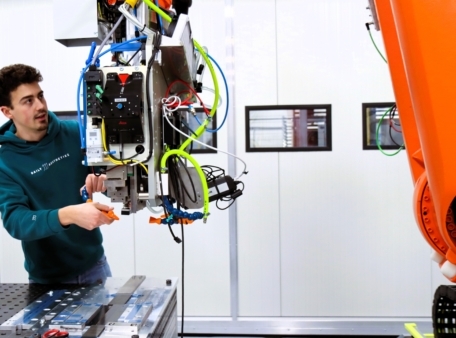
We are developing various technologies for the application of thermoplastic composites in large structures, including aircraft. Within the HyWeld project, our aim is to use a combination of these two materials, thereby enabling new applications that do not yet exist. With hybrid welding technology, designers can reliably join components made from both materials. In this way, they combine the strong properties of thermoplastics with the well-established and scalable supply chain of thermosets. Our approach is to accelerate the transition to a future-proof aviation industry.
Phasing
We are using an aircraft door surround structure for this purpose. Strict certification requirements are central to every step. The project will be carried out in three phases:
- Definition of the demonstrator: selection of materials, design of the component, planning of mechanical tests and determination of the use case.
- Technology development: development and implementation of the bonding layer composition; research into different materials and bonding mechanisms; optimisation for both flat and curved components.
- Demonstration and testing: production and welding of representative components; performance assessment and testing in Airbus-qualified test facilities.
Funding
This project is funded bij the Ministry of Economic Affairs and Climate Policy, within the programme: “TopSector High Tech Vliegtuigmaakindustrie (TSH)”.