Although new technologies in continuous ultrasonic welding and thermoforming of thermoplastic composites have been proven effective, these innovations are not yet ready for the industry. This project leads the concepts to workable manufacturing capabilities for XL thermoplastic structures.
Purpose
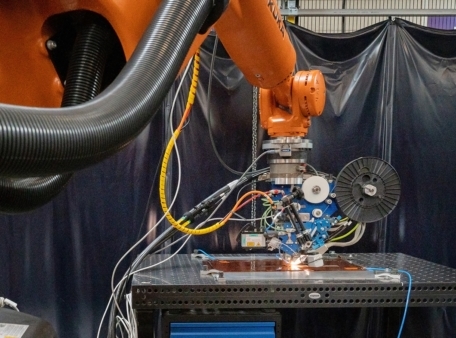
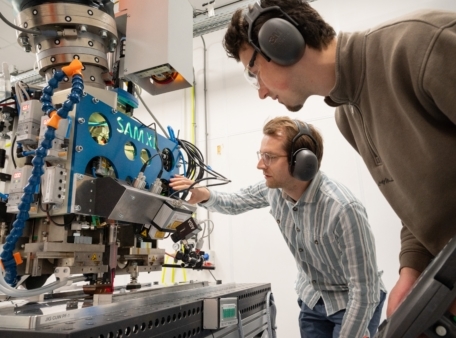
The goal of the overarching “Aerospace in Transition” programme is contributing to sustainable aviation. In the Aerofusion project, we are setting the next steps towards large scale manufacturing of lighter aircraft, by using thermoplastic composites. We want to gain fundamental knowledge on the basic principles for the assembly process of continuous ultrasonic welding of curved materials. In the past years, SAM XL has developed ultrasonic welding technology and has reached high quality welds on flat panels. The next challenge to overcome: creating the standard for curved shapes. While SAM XL focuses on the ultrasonic welding process, our partner Cato Composites is developing a thermoforming process for high temperatures.
Phases
The first phase of the project concentrates on in depth research on curved continuous ultrasonic welding and defining quality criteria, specifications and requirements. Subsequently, a study will be conducted on how to perform high quality curved continuous ultrasonic welding for thermoplastic composites. In the final phase, various demonstrators will be developed, showcasing how curved skins with unidirectional thermoplastics can be joined with stiffening elements. This is crucial to understand the performance of the welded joints and to understand the effect of the welds on the material. Throughout the entire project, in depth research will provide data on the performance of the welded joints in different conditions.
Context
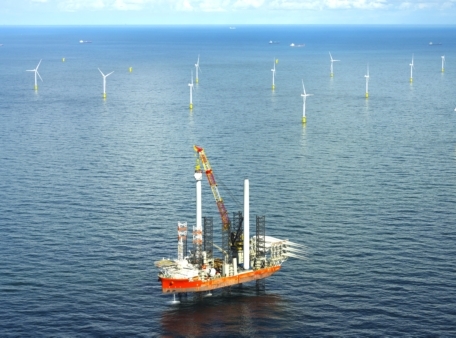
The knowledge gathered in this project is relevant on a global scale. Rapid assembly of aircraft (and other large structures) with lighter and recyclable material, with reduced CO2 emissions and with the highest quality and safety standards is essential to decrease the ecological footprint of aviation. SAM XL’s outlook is to develop the ultrasonic welding technology towards higher TRL (Technology Readiness Level), to serve the XL manufacturing industry in creating complex, large objects with lighter material than traditional metal structures. The EU economic potential for this technology is not limited to aerospace manufacturing, but is also relevant for the maritime, civil and off shore industry.
Funding
This project is funded bij the Dutch National Growth Fund (Nationaal Groeifonds) through the Aerospace in Transition programme.
Find more information at www.luchtvaartintransitie.nl (in Dutch)