In the factory of the future, workers will be supported by AI and AR tools. The aim of this project is to make jobs more attractive, more enjoyable and less stressful for employees that perform repetitive or complex tasks. Furthermore, some processes are too precise, complex or dangerous for human workers. The international demand for ‘first time right’ manufacturing processes is high. Therefore, autonomous robotic manufacturing needs to be further developed.
Objective
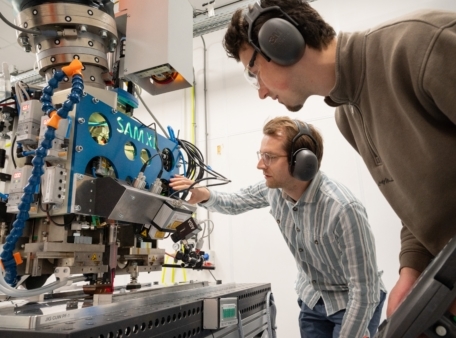
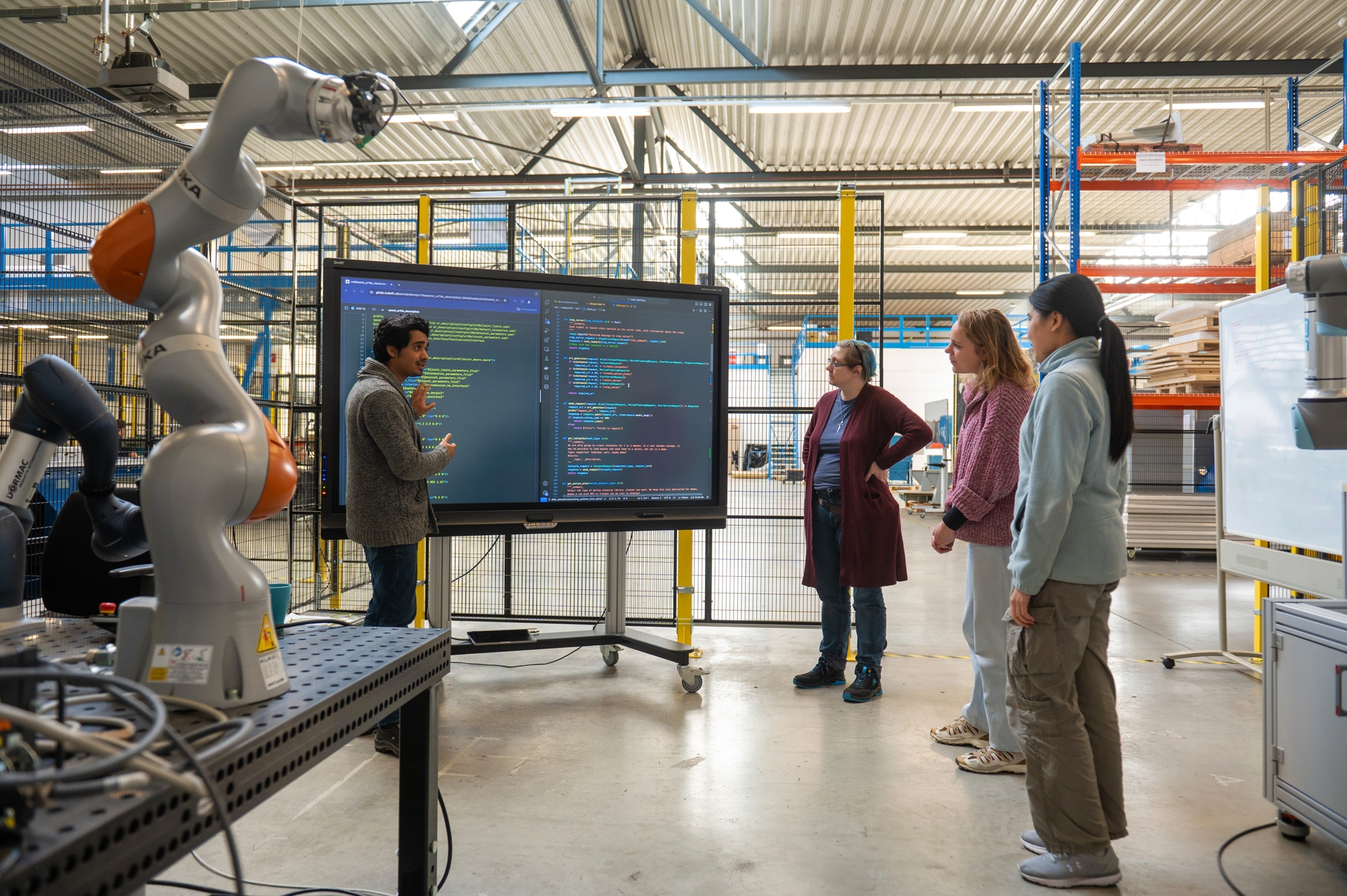
The aim is to develop AI tools that are useful to factory operators. To cover a wide manufacturing range, two pilot lines will be developed. The first pilot site is for mass production of PET bottles. Here, a multimodal AI supervisor is developed to monitor operators’ activities and predict their intentions. A Machine Learning-Based Digital Twin will capture over 130 temperature points, pressure signals, and cycle timings, feeding predictive algorithms for monitoring and optimisation. The assistant will give real-time assistance, e.g. by providing instructions for safety, ergonomics or showing the next steps with the aid of an AR environment. The second pilot site (at SAM XL) revolves around low volume, high complexity manufacturing. In this pilot line, our process for AFP (Automated Fiber Placement) will be digitally upgraded.
Pilot line at SAM XL
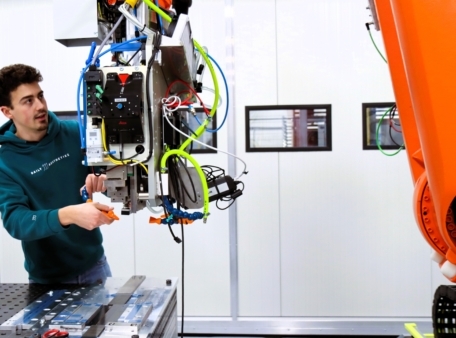
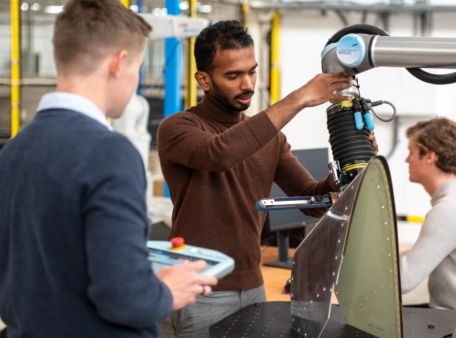
In our AFP (Automated Fiber Placement) pilot line, we will develop and validate new AI powered tools to assist the manufacturing operator. We will use an actual, full size, curved mold for an airplane part, provided by Collins Aerospace.
1) Making an AI assistant which is aware of what is going on inside the robot cell:
- Installing sensors so the AI can sense the human operator’s position and can predict the intention (e.g. just walking past, inspecting something or approaching to perform maintenance)
- Creating a digital twin of the robot, so the AI is aware of where the robot is
2) Adding AFP process monitoring sensors to detect AFP defects and intelligent determination of:
- A small defect which can be automatically corrected in-line
- A larger defect which needs to be corrected with a re-pass
- An unrecoverable defect; the system calls for operator intervention.
3) The AI then guides the operator through the following steps:
- After implementing Augmented Reality tools, the AI can visually communicate to the operator about the next step and the needed actions
- The intention is to give the AI supportive ways to move the robot, e.g. to make space for the operator to inspect the production part.
Collaborative R&D
The integral approach with seven companies jointly collaborating to create these new processes, is challenging and demanding. Combined all together, all these tools create closed-loop interactions between workers, machines and management systems. The investigation of social and psychological factors shaping acceptance of AI- and AR-based assistive technologies in advanced manufacturing is also included. The aim is to use the learnings from this holistic approach to enable predictive guidance, ergonomic optimisation and early risk prevention. Expected outcomes include reduced defect rates and downtime, improved ergonomics and well-being, faster worker upskilling through adaptive training modules, and actionable insights for EU Industry 5.0 policies. EMPOWR contributes directly to Europe’s twin green and digital transitions, positioning European manufacturing as more resilient, competitive, and attractive for current and future generations.
More information
For more information, please visit the corporate project site: https://empowr-project.eu/
Funding
This project is funded by The European Union.