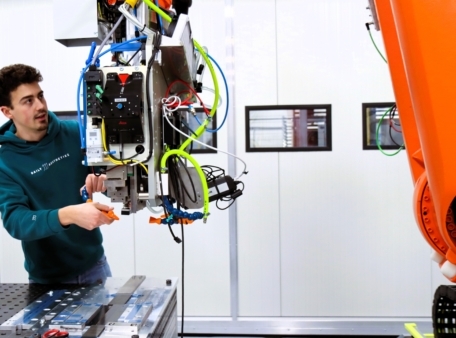
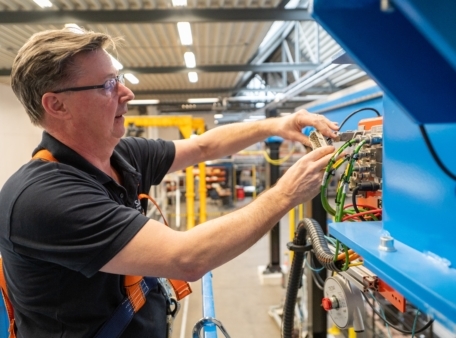
As a key economic pillar, the European manufacturing industry is under pressure in several respects. Increasing competition, labour shortages, rapid digital developments that require new skills, and the urgent need for sustainable, circular solutions are all reshaping the industrial landscape. Whereas efficiency and cost reduction used to be the primary drivers of the manufacturing industry’s decisions, innovations will need to deliver parallel solutions over the coming years.
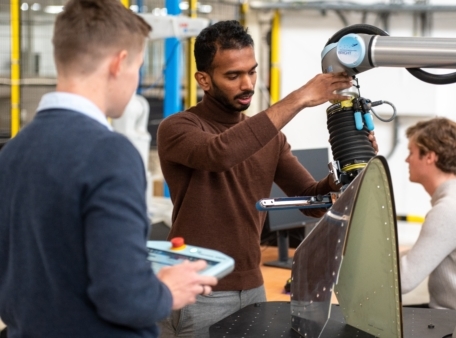
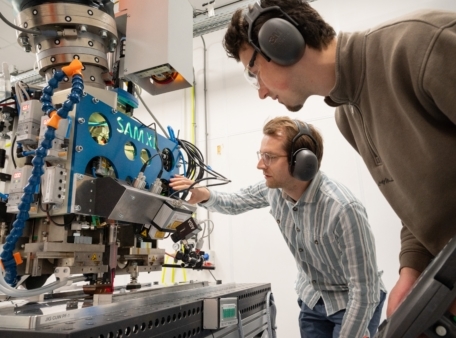
The market demands smart and fast methods for complex industrial processes. As a fieldlab, we bridge the gap between scientific research at TU Delft and other universities and manufacturing companies seeking to digitalise and automate their operations. Building on a proven track record in developing sustainable and intelligent robotics solutions for the aerospace industry, we are now, together with our partners, broadening our portfolio and expanding into new markets.
Strategic Market Sectors
The Smart Advanced Manufacturing solutions we have developed in recent years for XL structures can be applied broadly across other industries. If we can manufacture an aircraft using smart robotics and innovative materials, this expertise can also be leveraged for a wide range of other large-scale applications.
For the period 2026-2030, we have therefore chosen to focus on the following sectors:
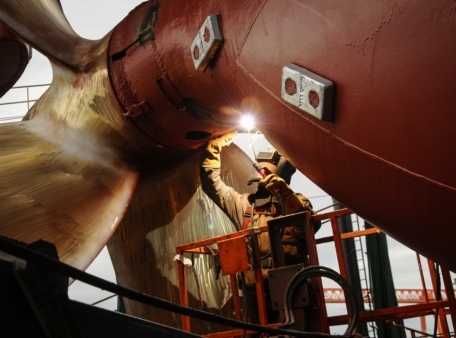
- Maritime: how can we help address the challenges that our Dutch shipbuilders are facing? How can we strengthen Europe’s position with flexible solutions for maintenance and repair processes?
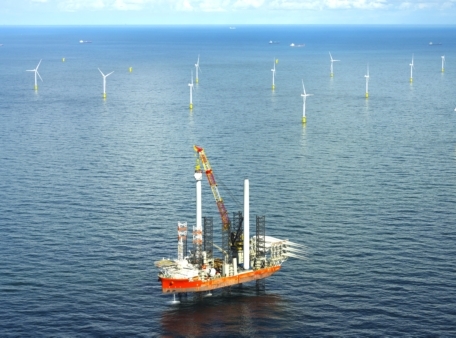
- Wind and offshore: what added value can we provide for the production, installation, and maintenance of massive structures, where accessibility and weather conditions present additional challenges?
- Civil engineering: from bridges and viaducts, to tunnels and dams; how can our expertise contribute to creating robust and sustainable solutions?
- Defense: how can we leverage our extensive knowledge of manufacturing, inspection, and maintenance to accelerate innovation and upscaling?
For all these sectors, we explore practical possibilities, seek new partnerships and knowledge sharing, and focus on strategic autonomy.
New Manufacturing Processes
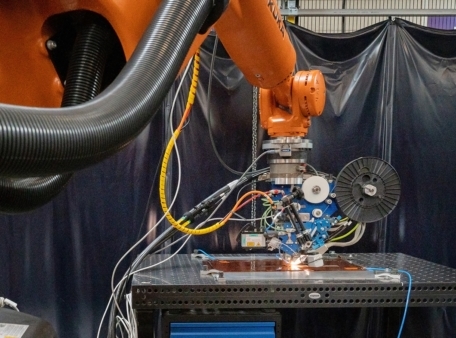
Rapid digital developments offer numerous new opportunities for industry. But where should companies invest? And what are reliable, sustainable and future-proof solutions? In response we apply our expertise to assist the industry as a neutral expert. In doing so, we focus on the added value that robots can provide. Think of dangerous work, heavy labor, tasks that are extremely time-consuming, or tasks that humans are simply unable to perform. Examples of applications with significant market interest include:
- Smart inspection robots for civil infrastructure (bridges, railways), to improve the predictability of service life
- Post-processing (milling, sanding, polishing) of large 3D-printed molds, for example for the
automotive industry
- Inspection and welding in hard-to-reach areas in shipbuilding (confined spaces)
- Automation of composite wind turbine blade production
- Scaling up drone and unmanned systems for aviation and maritime applications, in
collaboration with SMEs and scale-ups
- Mobile robotics for the post-processing of wind turbine blades (sanding, milling).
Accelerating innovations
Thanks to grants and support from strategic partners, this overarching project makes it possible to accelerate the development of innovations. As a fieldlab, SAM XL focuses on the mid-TRL (technology readiness level) range. For companies, it is generally too risky to invest in an innovative technology over the long term. That is why governments support innovative hubs where companies, together with scientists from universities and other research institutions, can develop, test, and validate new applications. With the right expertise, the failure rate is significantly reduced, the right partners and suppliers are identified to advance the innovation, and valuable knowledge is shared—knowledge that is necessary to further scale up the company’s level of expertise.
Funding
This project is co-funded by the European Regional Development Fund (ERDF) and made possible in part by the province of South Holland.
More Information
For more information, visit www.kvw3.kansenvoorwest.nl.